
- 30/04/2025
- Dr. Samrat Jankar
- 0 Comments
- Blog
Laparoscopic vs Open Surgery for Gallstones: Which One Is Better?
Are you or someone in your family dealing with gallstones? Has your doctor suggested a gallstone operation but you are confused about which type of surgery is best?
You are not alone. Every year, thousands of patients in India face the same confusion. The good news is — all three surgical options are safe and effective. You just need to understand which one is right for your condition.
In this guide, A renowned gastrointestinal and laparoscopic surgeon in Pune, Dr. Samrat Jankar, explains everything in simple language. No medical jargon. No confusion.
What Is a Cholecystectomy?
A cholecystectomy operation means surgically removing the gallbladder. It is the most common and permanent solution for gallstones. Your gallbladder is a small, pear-shaped organ sitting below your liver. It stores bile — a fluid that helps digest fats. When hard deposits called gallstones form inside, they can block bile flow and cause:
- Suddenly, sharp pain in the upper right abdomen
- Nausea and vomiting after fatty meals
- Fever with chills (sign of infection)
- Jaundice (yellowing of skin or eyes)
When these symptoms appear repeatedly, gall removal surgery is usually the best and most effective treatment.
Three Types of Gallbladder Surgery in 2026
There are three ways to perform a cholecystectomy by laparoscopy or open method:
- Laparoscopic cholecystectomy (keyhole surgery)
- Open surgery cholecystectomy
- Robotic cholecystectomy
Let us understand each one clearly.
Laparoscopic Cholecystectomy — The Gold Standard
Laparoscopic cholecystectomy is the most widely performed gallstone removal operation in Pune, India and worldwide. It is also called keyhole surgery or minimally invasive surgery.
How It Works
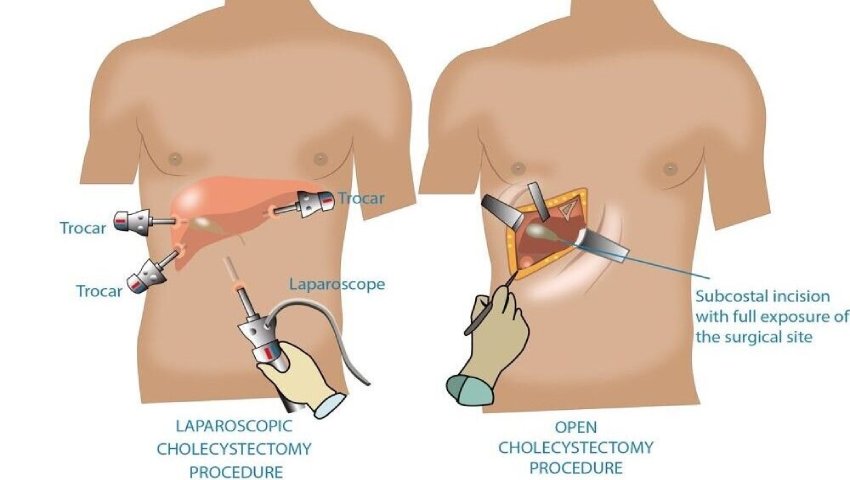
The surgeon makes 3 to 4 small cuts (each about 0.5 to 1 cm) in the abdomen. A tiny camera called a laparoscope is inserted through one cut. The surgeon watches the live video on a screen and removes the gallbladder using fine instruments.
The whole procedure usually takes 45 minutes to 1 hour.
Benefits of Laparoscopic Surgery
- Less pain after surgery compared to open method
- Smaller scars — cuts are just 0.5 to 1 cm
- Short hospital stay — most patients go home in 24 hours
- Faster recovery — return to work in 7 to 10 days
- Lower infection risk — less exposure of internal organs
- Better cosmetic result — barely visible scars
What the Research Says
A major 2024–25 meta-analysis studying over 7.5 million patients confirmed that laparoscopic cholecystectomy:
- Reduces mortality risk by 84% compared to open surgery
- Cuts hospital stay by an average of 4 days
- Lowers complication rates by more than 50%
This is why it is considered the gold standard for gallstone surgery today.
When Laparoscopic Surgery Is Not Suitable
The laparoscopic method may not always be possible. Your surgeon may avoid it if:
- The gallbladder is severely infected or has ruptured
- There are dense scar tissues from previous surgeries
- Uncontrolled bleeding occurs during the procedure
- The anatomy is unclear or very distorted
In such cases, the surgeon may need to switch to open surgery. This is a safe and planned decision — not an emergency.
Open Cholecystectomy — When It Is Still Needed
Open surgery cholecystectomy involves a single large cut (about 5 to 7 inches) on the right side of the abdomen. The surgeon directly removes the gallbladder through this opening.
Open surgery was the only method available before the 1980s. Today it is used selectively — but it remains an important and life-saving option in the right situations.
When Doctors Choose Open Surgery
Your surgeon may recommend open cholecystectomy in these situations:
- Acute cholecystitis — severe gallbladder inflammation with gangrene risk
- Gallbladder cancer — open method gives better access for complete removal
- Multiple previous abdominal surgeries — scar tissue blocks laparoscopic view
- Uncontrolled bleeding during the laparoscopic procedure
- Very large gallstones or anatomical abnormalities
- Cirrhosis of liver — liver disease changes the surgical approach
Recovery After Open Surgery
Open surgery requires a longer recovery:
- Hospital stay: 3 to 5 days
- Return to normal activity: 4 to 6 weeks
- Pain level: Higher, needs stronger pain management
- Scar: Visible scar on right abdomen, typically 5 to 7 inches
Open surgery is not inferior — it is simply the better choice in complex cases. In experienced hands, outcomes are excellent.
Robotic Gallbladder Surgery — Is It Worth It?
Robotic surgery is the newest addition to gallstone treatment. The surgeon uses a robotic system (such as the da Vinci robot) to perform the operation with greater precision and control. Both surgeries use small cuts and a camera. But there are key differences:
- Incision size — Same in both: 3 to 4 small cuts
- Camera view — Laparoscopic gives a 2D flat view. Robotic gives a 3D high-definition view
- Instrument movement — Laparoscopic uses the surgeon’s direct hand. Robotic uses robot-assisted precision movements
- Hospital stay — Same in both: 1 day
- Complex cases — Both handle complex cases, but robotic is better suited for difficult anatomy
- Cost in India — Laparoscopic costs ₹60,000 to ₹1,20,000. Robotic costs ₹2,50,000 to ₹4,00,000
Does Robotic Surgery Give Better Results?
According to the same 2024–25 global meta-analysis, robotic surgery showed no significant clinical advantage over standard laparoscopic surgery for routine gallbladder removal. Recovery time, complications, and hospital stay are similar.
However, robotic surgery offers real advantages in:
- Obese patients with limited abdominal space
- Patients with previous multiple surgeries
- Very complex gallbladder anatomy
- Training and precision in difficult dissections
Dr. Samrat Jankar’s view: For most patients, laparoscopic cholecystectomy gives excellent results at a fraction of the cost. Robotic surgery is best reserved for complex or high-risk cases where its precision truly makes a difference.
Which Surgery Is Right for You? A Simple Decision Guide
This is the most important question — and the answer depends on your specific condition.
Choose Laparoscopic Surgery If:
- You have uncomplicated gallstones with no major infection
- You want faster recovery and smaller scars
- You have no major previous abdominal surgeries
- You are otherwise healthy with no serious medical conditions
Choose Open Surgery If:
- Your gallbladder is severely infected, gangrenous, or perforated
- You have dense abdominal adhesions from old surgeries
- Laparoscopic view is not possible due to anatomy
- Your surgeon decides conversion is necessary during the procedure
Consider Robotic Surgery If:
- You have a complex case and the facility is available
- Your surgeon recommends it for a specific reason
- Cost is not a barrier for you
Most important advice: Always follow your surgeon’s recommendation. No online guide can replace a proper clinical evaluation.
When Laparoscopic Surgery Converts to Open — What Patients Must Know
Many patients get worried when they hear that their laparoscopic surgery was “converted” to open surgery. They feel something went wrong. That is a myth. Conversion is a safe, planned decision — not a failure.
Common Reasons for Conversion
- Unclear anatomy making it unsafe to continue laparoscopically
- Excessive bleeding that needs direct control
- Unexpected gallbladder cancer discovered during surgery
- Dense adhesions blocking the laparoscopic instruments
Conversion rate in India ranges from 5% to 15% depending on the complexity of the case. In experienced surgical centres, it is much lower. Your surgeon’s priority is your safety — not completing surgery through one particular method.
Recovery Guide: Week by Week
After Laparoscopic Surgery
Day 1–2: Mild soreness around the cuts. Most patients walk the same day. Discharged in 24–48 hours.
Week 1–2 at home:
- Eat light, low-fat meals — dal, khichdi, curd rice, boiled vegetables
- Avoid spicy, fried, and heavy food
- Take short walks. Avoid lifting heavy objects
- Keep wound area dry and clean
Week 3–4:
- Gradually increase physical activity
- Most desk-job workers can return to work
- Avoid heavy exercise or gym for 4 weeks
Month 2 onwards:
- A normal diet can usually resume
- Full physical activity allowed
- Your body adjusts to life without a gallbladder — digestion improves over time
After Open Surgery
Expect a longer recovery of 4 to 6 weeks. Pain management is important. Follow your surgeon’s specific instructions for wound care and diet.
Conclusion:
Both laparoscopic cholecystectomy and open surgery cholecystectomy are effective, safe, and proven methods for gallstone operation. The right choice depends on your condition, anatomy, and your surgeon’s expertise.
For most patients in India today, laparoscopic surgery offers the best combination of safety, fast recovery, and minimal scarring. Robotic surgery adds precision in complex cases. Open surgery remains the preferred method when patient safety demands it.
The most important step? Consult a qualified laparoscopic surgeon, Dr Samrat Jankar, who can evaluate your specific condition and give you personalised advice.
FAQs About Laparoscopic vs Open Surgery for Gallstones
Laparoscopic surgery is better for most patients. It gives faster recovery, less pain, and smaller scars. Open surgery is better in complex or emergency cases.
Yes, it is very safe. It is the most commonly performed abdominal surgery globally, with an excellent safety record backed by decades of research.
It is technically a major surgery since it involves general anaesthesia and organ removal. But the recovery is much faster than traditional open surgery — most patients go home in 24 hours.
Not always. Patients with severe infection, complicated anatomy, or previous multiple surgeries may need open surgery. Your surgeon will evaluate and advise accordingly.
For patient safety. If the view is unclear, bleeding is difficult to control, or the anatomy is too complex, converting to open surgery is the safest decision.
Open cholecystectomy usually takes 1 to 2 hours, depending on the complexity of the case.
Most patients recover fully in 2 to 4 weeks. Desk-job workers can return in 7 to 10 days.