
- 079041 39064 Call Us Now
- gastrosamrat@gmail.com Email Us
Hiatus/Hiatal Hernia Treatment in Pune
- Do you feel a burning sensation in your chest after meals?
- Does acid keep coming back into your throat?
- Do you often have chest pain, belching, or trouble swallowing?
These are not just signs of indigestion. They could be symptoms of a hiatal hernia — and you deserve a proper diagnosis.
If you are searching for the best hiatal hernia treatment in Pune, you are in the right place. Dr. Samrat Jankar is one of Pune’s most trusted hiatus hernia specialists and a leading laparoscopic hernia surgeon in Pune. He is a Surgical Gastroenterologist with 17+ years of clinical experience. He has performed over 1,000 hernia repair surgeries using advanced minimally invasive techniques at Kaizen Gastro Care, Wakad, Pune.
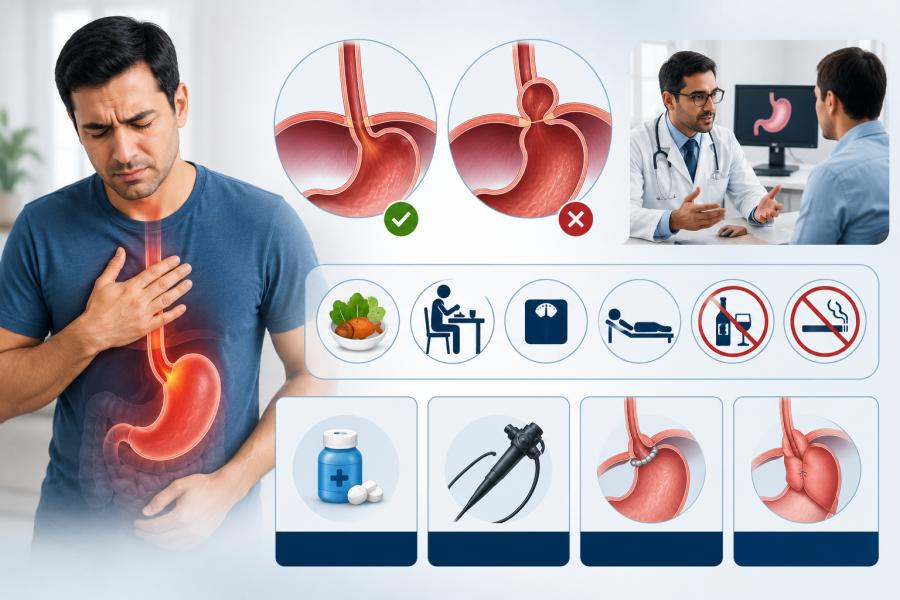
He is both a gastroenterologist and a GI surgeon. Hiatal hernia sits at the crossroads of digestive medicine and surgery. Most surgeons can operate — but not all can manage the complex digestive component before and after surgery. Dr. Jankar does both under one roof. Whether your hiatal hernia needs lifestyle changes, medication, or laparoscopic surgery, Dr. Jankar will create a treatment plan that fits you.
What Is a Hiatal Hernia (Hiatus Hernia)?
Many patients ask: “Is a hiatus hernia and hiatal hernia the same thing?”
Yes. Both names refer to the exact same condition.
Hiatus hernia definition:
A hiatal hernia occurs when the upper part of the stomach pushes up through an opening in the diaphragm — called the diaphragmatic hiatus — and into the chest cavity.
Let us break that down simply.
The diaphragm is a muscle that separates the chest and abdomen. A small opening in it allows the food pipe to connect to the stomach. Normally, the stomach stays below the diaphragm. In a hiatal hernia, part of the stomach moves upward into the chest through this opening. This can weaken the acid-control valve and cause heartburn or acid reflux. Unlike other hernias, a hiatal hernia is internal and does not create a visible bulge, so symptoms are often ignored for months.
4 Types of Hiatal Hernia — Explained Simply:
Not all hiatal hernias are the same. There are four types, and your treatment depends on which type you have.
- Type I — Sliding Hiatal Hernia (Most Common): This is the most common type. It accounts for 95% of all hiatal hernias. Here, the gastroesophageal junction (where the oesophagus meets the stomach) slides up through the hiatus into the chest. It does not stay there permanently — it slides in and out. Sliding hiatal hernias are closely linked to GERD (acid reflux disease). Most patients with this type can be managed with lifestyle changes and medications. Surgery is only needed when symptoms cannot be controlled.
- Type II — Rolling (Paraesophageal) Hernia: In this type, part of the stomach bulges upward through the hiatus and sits alongside the oesophagus, like a rolling motion. The junction between the oesophagus and stomach stays in its normal position. This type is less common but carries a higher risk of complications. Surgery is often recommended even when symptoms are mild.
- Type III — Mixed Hernia: This is a combination of Type I and Type II. Both the gastroesophageal junction and part of the stomach herniate through the hiatus. This type tends to be larger and causes more severe symptoms. Surgical repair is usually necessary.
- Type IV — Complex Hernia (Rare): This is the rarest and most serious type. The hiatus opening is so wide that not just the stomach — but other organs like the colon, small intestine, spleen, or pancreas — also herniate into the chest. Type IV hiatal hernias require prompt surgical treatment.
Summary: Type I is managed medically in most cases. Types II, III, and IV generally require surgical repair. Dr. Jankar will evaluate your type through proper investigation and advise accordingly.
What Causes a Hiatal Hernia?:
The exact cause is not always clear. But several factors can lead to a weakened diaphragmatic hiatus.
Common causes and risk factors include:
- Age-related muscle weakening — The diaphragm muscles weaken over time. Hiatal hernias are more common in people over 50.
- Chronic increased abdominal pressure — Repeated coughing, straining during bowel movements, heavy lifting, or persistent vomiting.
- Obesity — Extra weight pushes upward on the stomach and diaphragm, widening the hiatus.
- Pregnancy — Increased intra-abdominal pressure during pregnancy.
- Congenital hiatus — Some people are born with a larger-than-normal opening in the diaphragm.
- Previous surgery — Prior abdominal or oesophageal surgeries can weaken the surrounding structures.
- Gender — Hiatal hernias are more common in women than men.
Symptoms of Hiatal Hernia — What to Watch For?
Many people live with a small hiatal hernia and have no symptoms at all. It is often found accidentally during an endoscopy done for another reason. But when symptoms do appear, they can significantly affect your quality of life.
Common hiatal hernia symptoms include:
- Persistent heartburn — a burning feeling in the chest or throat, especially after meals
- Acid reflux / GERD — stomach acid flowing back up into the food pipe
- Difficulty swallowing (dysphagia) — food feels stuck in the chest or throat
- Chest pain or pressure — often mistaken for a heart problem
- Regurgitation — food or liquid coming back up
- Frequent belching or bloating
- A feeling of a lump in the throat
- Hoarseness or a sore throat — from acid irritating the vocal cords
- Shortness of breath in large hernias — the stomach presses on the lungs
Important: Many of these symptoms overlap with heart disease. If you have chest pain, always get it checked by a doctor first.
When Is It an Emergency?
Go to the hospital immediately if you experience:
- Sudden severe chest or stomach pain
- Inability to swallow anything — even liquids
- Persistent vomiting you cannot stop
- Feeling very unwell with rapid deterioration
This could mean the hernia has become strangulated — a medical emergency where the blood supply to trapped stomach tissue is cut off.
How is a hiatal hernia diagnosed by Dr. Samrat Jankar?
Getting the right diagnosis is the first step to the right treatment.
At Kaizen Gastro Care, Dr. Samrat Jankar follows a thorough diagnostic process.
- Detailed medical history: Jankar discusses your symptoms, eating habits, lifestyle, and previous medical or surgical history.
- Upper GI Endoscopy (OGD): A thin, flexible camera is passed gently through your mouth into your oesophagus and stomach. This is the most accurate way to confirm a hiatal hernia and check for complications like oesophagitis or Barrett’s oesophagus.
- Barium Swallow X-ray: You swallow a contrast liquid that coats the food pipe and stomach. X-ray images then clearly show the hernia and how the stomach sits relative to the diaphragm.
- CT Scan: Used for larger, complex hernias (Type III or IV) to assess the size, contents, and surgical planning.
- Oesophageal Manometry: Measures the pressure and movement in your food pipe. This is done before surgery to plan the type of fundoplication (stomach wrap) needed.
- 24-Hour pH Monitoring: A small probe measures acid levels in your oesophagus over a full day. This confirms whether GERD is present and how severe it is.
Hiatal Hernia Treatment Options in Pune:
Treatment depends on the type of hernia, the severity of your symptoms, and your overall health. There are three main paths: lifestyle management, medication, and surgery.
Option 1 — Laparoscopic Hiatal Hernia Surgery (Fundoplication):
When surgery is needed, laparoscopic Nissen fundoplication is the gold standard treatment worldwide — and Dr. Jankar’s most performed hiatal hernia procedure.
How the surgery works?
The surgery is performed through 3–5 small incisions (5–10 mm). A laparoscope (tiny camera) gives the surgeon a magnified view inside.
The surgeon:
- Gently pulls the stomach back down below the diaphragm.
- Tightens the widened hiatal opening (cruroplasty)
- Wraps the upper part of the stomach around the lower oesophagus — this is called fundoplication. It recreates the valve that prevents acid from flowing back up.
For patients with impaired oesophageal motility, Toupet fundoplication (partial wrap) may be preferred over Nissen (full wrap). Dr. Jankar selects the technique based on pre-operative manometry results.
Benefits of laparoscopic hiatal hernia repair:
- Only 3–5 tiny cuts — minimal scarring
- Much less pain compared to open surgery
- Hospital stay of 1–2 days
- Return to light activities in 10–14 days
- Excellent long-term reflux control
- Low recurrence when performed by an experienced surgeon
Option 2 — Hiatal Hernia Mesh Repair:
In some cases — especially for large hernias (Type II, III, IV) or recurrent hernias — a surgical mesh is placed around the hiatus to reinforce the repair and reduce the risk of the hernia coming back.
Hiatal hernia mesh repair is not used routinely. Dr. Jankar carefully evaluates each patient to decide whether mesh is appropriate. The mesh provides extra structural support where the diaphragm muscle is very thin or weak.
Option 3 — Open Surgical Repair:
Open surgery is reserved for very large, complex, or recurrent hernias that cannot be safely approached laparoscopically. It involves a larger abdominal or chest incision and requires a longer recovery of 4–6 weeks.
Option 4 — Robotic Hiatal Hernia Repair:
For complex Type III or Type IV cases, Dr. Jankar also offers robotic-assisted hiatal hernia surgery. The robotic system provides 3D magnified vision and greater precision — especially valuable when operating close to the oesophagus and diaphragm.
Hiatus Hernia Surgery Cost in Pune:
The cost of hiatus hernia surgery in Pune varies based on several factors.
Factors that affect the cost:
- Type of surgery chosen (laparoscopic surgery, mesh repair, open, or robotic)
- Type of hernia (I, II, III, or IV) — complex types cost more
- Need for mesh implant
- Pre-operative investigations (endoscopy, manometry, pH test)
- Hospital room type and duration of stay
- Post-operative care requirements
General cost range in Pune:
- Laparoscopic fundoplication (Nissen/Toupet): ₹70,000 – ₹1,50,000
- Laparoscopic hiatal hernia mesh repair: ₹90,000 – ₹2,00,000
- Robotic hiatal hernia repair: ₹1,20,000 – ₹2,50,000
- Open hiatal hernia repair: ₹60,000 – ₹1,20,000
Why Choose Dr. Samrat Jankar for Hiatal Hernia Treatment in Pune?
Choosing the right specialist for a hiatal hernia matters — it is not just a surgical problem. It is a digestive condition that requires expert medical and surgical management together. Here is why patients across Pune, PCMC, and Maharashtra trust Dr. Samrat Jankar:
- 17+ years of experience in surgical gastroenterology and GI surgery
- 1,000+ successful hernia surgeries via laparoscopic technique
- Dual expertise — Gastroenterologist + GI Surgeon. He manages your condition both medically and surgically.
- Expert in laparoscopic Nissen fundoplication, mesh repair, and robotic hernia surgery
- Handles complex and recurrent hiatal hernias that other centres may refer elsewhere
- Personalised treatment plans — no one-size-fits-all approach
- Practices at Kaizen Gastro Care, Wakad, Pune — a fully equipped speciality GI centre
- Serves patients from Pune, PCMC, Pimpri-Chinchwad, Wakad, and across Maharashtra
- Known for clear communication — he explains your diagnosis and all options in simple language
Book Your Consultation With Dr. Samrat Jankar:
Persistent heartburn and chest pain are not something you should just live with. They are your body telling you something is wrong. A proper diagnosis can make an enormous difference — and early treatment means a simpler solution.
Dr. Samrat Jankar at Dr. Samrat Jankar Clinic, Pune, is ready to help. He will assess your condition thoroughly, explain your diagnosis clearly, and recommend the best treatment approach for your specific situation.
- Call: 079041 39064
- Email: gastrosamrat@gmail.com
- Dr. Samrat Jankar Clinic Location -Shop 208-209, Oriana Crest Building, Datta Mandir Road, Opp. Costa Rica Society, Wakad, Pune, Maharashtra
FAQ's Hiatus Hernia:
Yes. They are the same condition. “Hiatus” refers to the opening in the diaphragm. “Hiatal” is the adjective form of hiatus. Both names are used interchangeably by doctors worldwide.
Small sliding hernias (Type I) can often be managed long-term with lifestyle changes and medications. This controls symptoms but does not permanently fix the hernia. Surgery is the only way to repair the hernia itself. Your doctor will recommend surgery if medications stop working, if the hernia grows, or if complications develop.
Avoid spicy food, fatty or fried food, chocolate, citrus fruits, tomatoes, onions, garlic, caffeine, alcohol, and carbonated drinks. These relax the lower oesophageal sphincter and worsen acid reflux.
Most small hiatal hernias are not dangerous and cause only mild symptoms. However, large paraesophageal hernias (Type II, III, IV) can become serious if the stomach becomes trapped or the blood supply is cut off (strangulation). This is a surgical emergency. That is why early diagnosis and monitoring are important.
They are related but not the same. A hiatal hernia is a structural problem — the stomach has moved into the chest. GERD (acid reflux disease) is a symptom — stomach acid flows back into the food pipe. A hiatal hernia can cause GERD, but GERD can also occur without a hiatal hernia. Both need to be diagnosed and treated correctly.
After laparoscopic surgery, most patients return to light activities within 10–14 days. A soft diet is recommended for 4–6 weeks while the repaired area heals. Full recovery typically takes 4–6 weeks. After open surgery, recovery takes 6–8 weeks. Dr. Jankar provides a detailed, personalised recovery plan for every patient.
The ICD-10 codes used for hiatus hernia are:
- k44.0 — Hiatus hernia with obstruction, without gangrene
- k44.1 — Hiatus hernia with gangrene
- k44.9 — Hiatus hernia without obstruction or gangrene (most commonly used)