
- 079041 39064 Call Us Now
- gastrosamrat@gmail.com Email Us
Inguinal Hernia Treatment in Pune
If you are looking for the most effective Inguinal Hernia Treatment in Pune, Dr. Samrat Jankar provides world-class, minimally invasive solutions with a focus on fast recovery and permanent results. As an ACRSI Gold Medalist and Surgical Gastroenterologist with over 17+ years of experience, Dr. Samrat Jankar has successfully performed 3,000+ laparoscopic surgeries. At Kaizen Gastro Care, Wakad, he specializes in advanced TEP and TAPP techniques, allowing most patients to go home the same day with minimal pain and nearly invisible scars.
Recognized as a leading expert for Hernia Treatment in Pune, Dr. Samrat Jankar is trusted for his precision in handling complex and recurrent cases. By utilizing the latest Robotic and Laparoscopic technology, he ensures a significantly lower risk of recurrence and a quick return to daily life—most patients return to work within 7–10 days. Don’t ignore the discomfort; choose Pune’s highly qualified hernia specialist for a safe, pain-free, and permanent cure.
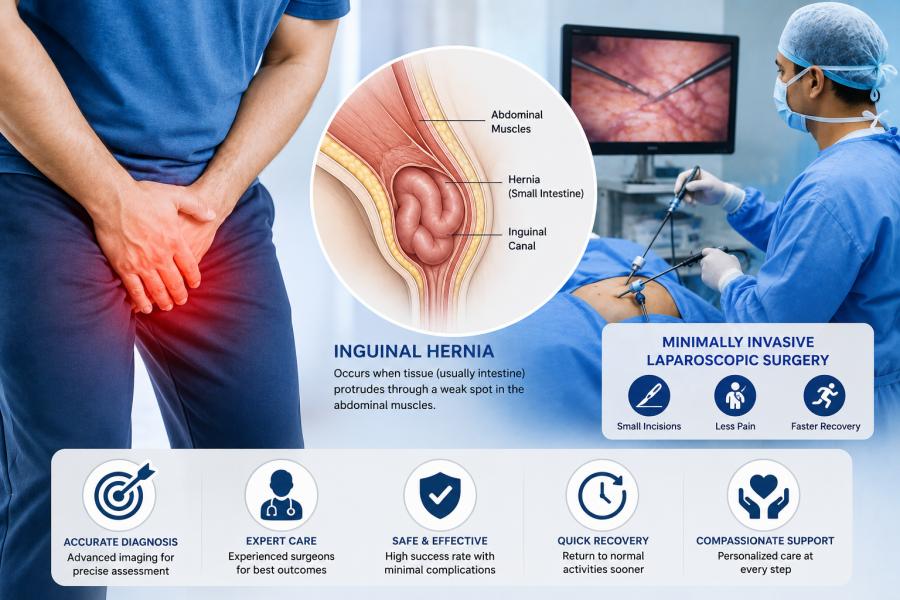
What Is an Inguinal Hernia?
An inguinal hernia is also called a groin hernia. It happens when part of your intestine or fatty tissue pushes through a weak spot in your lower abdomen.
This weak spot is in the inguinal region. This is the area between your lower belly and upper thigh. Inside this region, there is a passage called the inguinal canal. When the muscles here become weak, tissue can push through and form a bulge. You may see or feel a soft lump in your groin area. This lump often becomes bigger when you cough, sneeze, or lift something heavy. It may disappear when you lie down.
Inguinal hernia is the most common type of hernia. It is seen more often in men than in women. But women and children can also get it.
The good news is that it is fully treatable. With modern laparoscopic surgery, recovery is fast, and pain is minimal.
Book an Appointment
Enter details, our team would approach you to help you as soon as possible.
Where Is the Inguinal Region?
The inguinal region is the lower part of your abdomen, on both the right and left sides. It connects your belly to your thigh. It is also called the groin area.
Inside the inguinal region, there is a passage called the inguinal canal. This canal is different in men and women.
- In men, the inguinal canal carries the spermatic cord. This cord connects the testes to the body. The canal is wider in men. This is why inguinal hernias are much more common in men.
- In women, the inguinal canal carries the round ligament. This ligament holds the uterus in place. Women can also get inguinal hernias, though less often than men.
The left inguinal region and the right inguinal region can both be affected. Sometimes, both sides have a hernia at the same time. This is called a bilateral inguinal hernia. Laparoscopic surgery can repair both sides in a single operation — without needing two separate surgeries.
Types of Inguinal Hernia:
1. Indirect Inguinal Hernia (Most Common — 80% of cases): This is the most common type of inguinal hernia. It happens when tissue passes through the natural opening of the inguinal canal. It can be present from birth or develop later in life. In men, it often moves down towards the scrotum.
- Who gets it: Men of all ages, including children and young adults.
2. Direct Inguinal Hernia: Here, the tissue pushes directly through a weakened area in the abdominal wall. It does not pass through the inguinal canal. This usually happens because the muscles weaken over time due to age or strain.
- Who gets it: Usually older adults. More common in men.
3. Bilateral Inguinal Hernia (Both Sides): Both the left inguinal region and the right inguinal region have a hernia at the same time. This is more common in men. The advantage of laparoscopic surgery is that both sides can be fixed in a single operation.
- Treatment: One laparoscopic operation to fix both sides together.
What Are the Symptoms of an Inguinal Hernia?
Common symptoms to watch for
- A soft bulge or lump in the groin area — on one or both sides
- The bulge becomes bigger when you cough, sneeze, or strain
- The lump may disappear when you lie down
- Mild pain or discomfort in the groin — especially when bending or lifting
- A feeling of heaviness or pressure in the groin
- In men — swelling around the scrotum or testicles
- A burning or aching feeling in the groin
Who is at risk?
- Men (especially over 40 years of age)
- People who do heavy lifting regularly
- Those with chronic cough or constipation
- People who are overweight or obese
- Those with a family history of hernia
- People who have had previous abdominal surgery
- Smokers
What Causes an Inguinal Hernia?
An inguinal hernia happens because of weakness in the abdominal wall muscles. This weakness can be present from birth or develop over time. When pressure builds up in the abdomen — such as during lifting or straining — tissue pushes through this weak spot.
Common causes:
- Heavy lifting: Lifting heavy weights repeatedly puts too much pressure on the abdominal wall. This can cause or worsen a hernia.
- Chronic cough: Long-term coughing from smoking, asthma, or lung disease increases abdominal pressure again and again over time.
- Constipation and straining: Straining during bowel movements puts repeated pressure on the muscles of the groin area.
- Obesity: Extra body weight puts constant pressure on the abdominal muscles every day.
- Family history: If a close relative had an inguinal hernia, your risk is higher due to inherited muscle weakness.
- Previous surgery: An old surgical scar in the abdominal area can create a weak spot. This can lead to a hernia later in life.
How is an inguinal hernia diagnosed in Pune?
Dr. Samrat Jankar diagnoses an inguinal hernia in a simple and comfortable way. Most cases are confirmed in the very first consultation.
- Physical examination: Dr. Jankar gently feels the groin area. He may ask you to cough or strain lightly. This makes the hernia bulge visible and helps confirm the diagnosis.
- Medical history review: He asks about your symptoms, how long you have had them, your lifestyle, and any past surgeries or health conditions.
- Imaging tests (if needed): If the hernia is small or not clearly visible, an ultrasound, CT scan, or MRI may be recommended. This helps confirm the diagnosis and plan surgery better.
- Personalised treatment plan: After diagnosis, Dr. Samrat Jankar explains your condition in simple words. He tells you the best treatment option based on your specific case, age, and overall health.
Inguinal Hernia Treatment Options in Pune:
Important note for patients: Can inguinal hernia be treated without operation? No. An inguinal hernia will not go away on its own. Home remedies, belts, and trusses only give temporary relief. They do not cure the hernia. The only permanent treatment is surgery.
If your hernia is very small and has no symptoms, Dr. Jankar may recommend watching and waiting for a short time. But surgery will be needed eventually.
Option 1 — Laparoscopic Hernia Repair: (Recommended for most patients)
This is the most advanced and preferred treatment today. The surgeon makes just 2–3 tiny cuts — each less than 1 cm. A small camera and tools are inserted. The hernia is repaired from inside the body. A surgical mesh is placed to strengthen the area and prevent the hernia from coming back.
Two techniques used by Dr. Samrat Jankar:
- TEP (Totally Extraperitoneal Repair): The hernia is repaired without entering the abdomen. This reduces the risk of internal organ injury. It is Dr. Jankar’s preferred technique for most patients. Recovery is very fast.
- TAPP (Transabdominal Preperitoneal Repair): The surgeon enters the abdomen to repair the hernia. This gives better visibility. It is ideal for complex, recurrent, or bilateral hernias.
Benefits of laparoscopic surgery:
- Less pain after surgery
- Smaller scars — almost invisible
- Back to light activities in 3–5 days
- Back to work in 7–10 days (for desk jobs)
- Shorter hospital stay — often same day
- Both sides can be fixed in one operation
- Lower risk of infection
Cost: ₹50,000 – ₹1,20,000 (approx.)
Option 2 — Open Hernia Repair:
This is the traditional method. The surgeon makes one larger cut in the groin. The hernia is pushed back in place, and the weakened area is stitched. A mesh may be placed for added strength.
It is a proven and effective surgery. It is used when laparoscopic surgery is not suitable for the patient.
Benefits:
- Time-tested technique
- Done under local or general anaesthesia
- Good for patients who cannot have laparoscopic surgery
- Suitable for some recurrent hernias
Cost: ₹35,000 – ₹80,000 (approx.)
Option 3 — Robotic Hernia Surgery:
The surgeon uses a robotic system with a 3D camera and robotic arms. This gives greater precision and control. The incisions are even smaller than standard laparoscopic surgery. It is best for complex, large, or recurrent hernias.
Benefits:
- Highest precision available today
- Very small incisions
- Minimal blood loss
- Faster return to daily life
- Excellent for difficult cases
Cost: ₹1,00,000 – ₹2,60,000 (approx.)
Inguinal Hernia Surgery Cost in Pune:
Surgery cost in Pune starts from ₹35,000 and goes up to ₹2,60,000 depending on the type of surgery and other factors. The average cost for laparoscopic hernia surgery in Pune is approximately ₹77,500.
What affects the total cost?
- Type of surgery: Open surgery costs less than laparoscopic. Robotic surgery costs the most. However, laparoscopic surgery gives much faster recovery — so you save money on hospital stays and missed work days.
- Hospital charges: Room type (general ward vs private room), operation theatre charges, and nursing care vary by hospital.
- Mesh quality: The type and brand of hernia mesh used affects cost. High-quality mesh reduces the risk of hernia coming back. We always use the best available mesh.
- Anaesthesia: The type of anaesthesia and the anaesthetist’s fees add to the total cost.
- Surgeon’s experience: A highly experienced Hernia surgeon like Dr. Samrat Jankar may charge more — but the lower risk of complications and recurrence saves you more in the long run.
Recovery After Inguinal Hernia Surgery in Pune:
Recovery timeline:
- Day 1: You can walk and drink liquids within a few hours after surgery. Most laparoscopic hernia patients go home the same day.
- Week 1: Light walking is encouraged. Avoid heavy lifting, driving, and strenuous activity. Pain is minimal and controlled with tablets.
- Week 2–3: Most desk-job workers return to work. Pain reduces greatly. The wound heals well. You feel much better.
- Week 4–6: Full recovery for most patients. You can slowly return to exercise, gym, and physical work.
Why Patients in Pune Trust Dr. Samrat Jankar for Hernia Surgery?
17+ Years of Surgical Experience
Dr. Samrat Jankar has over 17 years of experience in gastrointestinal and hernia surgery. He has successfully performed 1,000+ laparoscopic hernia surgeries and treats both simple and complex hernias with excellent outcomes.
Board-certified hernia expert:
ACRSI-certified surgeon. Trained at India's top GI hospital. Gold medal winner. Not just a general surgeon — a dedicated GI and hernia specialist.
National & International Recognition
Dr. Samrat Jankar regularly presents advanced surgical techniques and complex case studies at national and international surgical conferences, staying updated with the latest developments in hernia and gastrointestinal surgery.
Research & Academic Contributions
He actively contributes to medical research and presents scientific papers on minimally invasive gastrointestinal and hernia surgery, helping improve patient care through evidence-based treatment.
Award-Winning Surgeon
Recipient of the Best Doctor in Pune (2025) by Outlook Magazine, Gold Medal Fellowship (ACRSI), and awards at FISTULACON and AMASICON for excellence in advanced laparoscopic and colorectal surgery.
Most advanced techniques available:
Expert in TEP, TAPP, IPOM, e-TEP, TAR, abdominal wall reconstruction, and robotic hernia surgery. Patients receive the latest minimally invasive treatment with less pain and faster recovery.
Same-day discharge for most patients:
Most laparoscopic hernia patients go home the same day. No long hospital stays. No unnecessary delays.
Doctor explains in simple language:
Dr. Jankar explains your condition and treatment clearly. You will never feel confused or pressured. Informed patients make confident decisions.
Insurance and EMI support:
Cashless surgery with all major insurers. No-cost EMI for all budgets. We handle all the paperwork.
Convenient location in PCMC:
Kaizen Gastro Care is in Wakad — easily accessible from Pimpri, Chinchwad, Hinjewadi, Baner, and central Pune.
Free follow-up consultations:
We stay in touch after surgery. Follow-up consultations are included. We make sure your recovery goes smoothly.
Expert in complex and recurrent hernias:
Recurrent hernias, bilateral hernias, large hernias, and abdominal wall reconstruction — Dr. Jankar handles the most difficult cases.
Find Our Hernia Specialist Clinic in Pune:
An inguinal hernia does not go away on its own. The sooner you get treatment, the easier, safer, and less expensive it is. A hernia that is treated early takes less time to heal. A hernia that is ignored can become a medical emergency. Book a consultation with Dr. Samrat Jankar today.
Serving patients from Wakad, Pimpri, Chinchwad, Baner, Hinjewadi, Kothrud, Hadapsar, Aundh, and all of Maharashtra.
- Samrat Jankar Clinic
- Address: Shop 208-209, Oriana Crest Building, Datta Mandir Road, Wakad, Pune – 411057
- Phone / WhatsApp: 079041 39064
Questions About Inguinal Hernia Treatment in Pune:
An inguinal hernia is when part of your intestine pushes through a weak spot in the groin. It will never go away on its own. In fact, it usually gets bigger and more painful with time. Without surgery, it can lead to serious complications. Surgery is the only permanent cure.
No. There is no medicine or home remedy that cures an inguinal hernia. A hernia belt or truss gives only temporary comfort — it does not treat the problem. It can even cause more damage if used incorrectly. Surgery is the only cure. Small hernias with no symptoms may be watched for a short time. But surgery is always needed in the end.
Laparoscopic inguinal hernia surgery takes approximately 45 to 60 minutes. Most patients are discharged on the same day or within 24 hours. You can walk and have liquids within a few hours of the surgery.
An indirect inguinal hernia passes through the inguinal canal. It is the most common type, responsible for about 80% of cases. It can happen at any age, including in children.
A direct inguinal hernia pushes through a weakened spot directly in the abdominal wall. It is more common in older adults. Both types are effectively treated with laparoscopic surgery.
After laparoscopic hernia surgery, most patients recover in 2–3 weeks. Desk-job workers can return to work in 7–10 days. Those doing physical work may need 4–6 weeks. Dr. Jankar gives personalised recovery instructions to every patient based on their surgery and lifestyle.
Dr. Samrat Jankar at Kaizen Gastro Care, Wakad, Pune, is one of the most experienced hernia specialists in Pune and PCMC. He holds an MBBS, MS, FMAS, and DNB in Surgical Gastroenterology. He has 17+ years of experience and has performed 3,000+ laparoscopic surgeries. Patients from Pimpri, Chinchwad, Baner, Hinjewadi, Kothrud, Hadapsar, and all of Pune and Maharashtra visit him regularly.
An untreated hernia can become incarcerated — the tissue gets stuck and cannot go back in. It can also become strangulated — the blood supply to the tissue is cut off. Strangulation is a life-threatening emergency that needs immediate surgery. It can cause permanent damage to the intestine. This is why Dr. Jankar always advises not to delay treatment, especially if you have a painful or growing hernia.