
- 18/03/2026
- Dr. Samrat Jankar
- 0 Comments
- Blog
Pilonidal Sinus vs. Pilonidal Cyst: Understanding the Key Differences
Are you experiencing pain, swelling, or a small lump near your tailbone? If yes, you might be confused between two common medical terms: Pilonidal Sinus and Pilonidal Cyst. Many patients use these terms interchangeably, but in the world of clinical medicine, they have distinct meanings and stages of progression.
At Kaizen Gastro Care, we believe that understanding your condition is the first step toward a permanent cure. In this blog, Dr. Samrat Jankar, a leading Surgical Gastroenterologist in Pune, explains the differences, symptoms, and the best treatment options available based on over 15 years of surgical experience.
The Confusion and the Common Link between Pilonidal Sinus and Cyst:
The area at the very bottom of your spine, just above the buttock crack, is called the sacrococcygeal region. This is where both pilonidal cysts and sinuses occur. These conditions primarily affect young adults, especially those who sit for long hours or have thick body hair.
The main goal of this blog is to clarify how a simple cyst can progress into a chronic sinus. If you are searching for the Best Colorectal Surgeon in Pune, it is likely because you want to know why this lump keeps coming back. Professional diagnosis is vital because the treatment for a simple cyst differs significantly from a complex sinus tract.
What is a Pilonidal Cyst?
A pilonidal cyst near the anus is essentially the starting point of this condition. While it can be uncomfortable, understanding how it forms is the first step toward managing it.
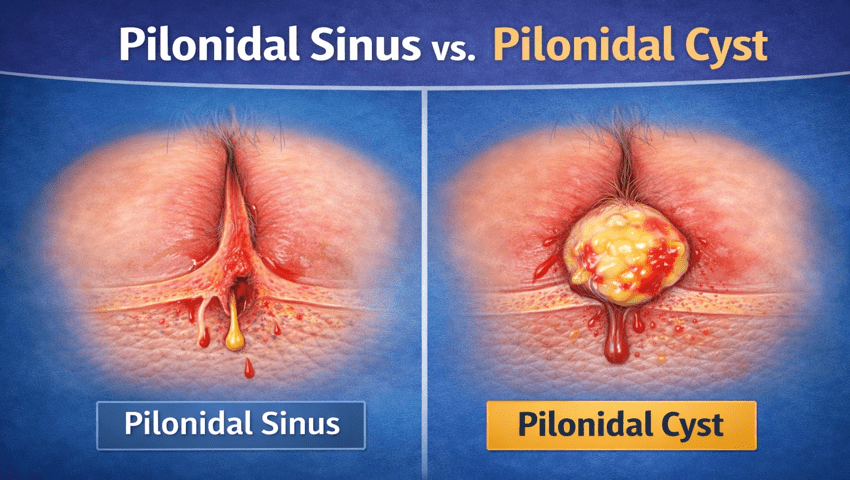
- A pilonidal cyst is a closed, sac-like structure located just under the skin. Think of it as a small, enclosed pocket. It typically develops when friction or pressure—often from prolonged sitting or tight clothing—forces pilonidal cyst hair naturally back into the skin. The body reacts to this hair as a foreign object, triggering an inflammatory response that forms a protective sac around it to wall it off.
The most important feature of a cyst is that it is an enclosed pocket filled with fluid, trapped hair, and skin debris.
At this stage:- There is often no visible hole or tunnel on the skin surface.
- You might feel a firm, sometimes tender lump.
- The area may become increasingly sensitive over time.
- While some minor cases can be managed with home care, persistent or infected cases often require medical intervention. If the cyst becomes an abscess or continues to recur, a doctor may recommend pilonidal cyst surgery to remove the sac and the trapped debris entirely, preventing future flare-ups.
What is a Pilonidal Sinus?
If a cyst is the pocket, a pilonidal sinus is the tunnel. Understanding the difference is crucial for choosing the right pilonidal sinus and treatment plan.
- A pilonidal sinus is a small tract or tunnel that connects the cavity under the skin to the surface. It often develops after a pilonidal cyst becomes infected and turns into an abscess (a painful buildup of pus). When this abscess ruptures or is drained, it leaves behind a permanent channel or sinus tract.
- The hallmark of a sinus is the presence of midline pits. These are tiny, pin-sized holes in the buttock crease. These pits act as the entrance for more hair to enter and the exit for infection to drain.
- Unlike a cyst, a sinus is an open system. This means:
- It frequently leaks pus, blood, or foul-smelling fluid.
- It can cause recurrent discomfort and skin irritation.
- It often requires a professional pilonidal sinus operation procedure to ensure the entire tract is addressed.
- Living with a chronic sinus can be difficult, as it rarely heals on its own. While conservative management exists for mild cases, most specialists recommend pilonidal sinus surgery to remove the pits and the underlying tract, significantly reducing the risk of the infection returning.
Key Differences at a Glance:
To help you identify your condition, here is a quick comparison table:
Symptoms and When to See a Doctor?
It is easy to ignore a small lump, but doing so can lead to complications. You should consult a specialist if you notice:
- Signs of Infection (Abscess): Sudden redness, heat in the area, intense pain while sitting, and sometimes fever.
- Chronic Signs: Persistent dampness in the tailbone area or yellowish/bloody stains on your clothing.
- Multiple Openings: If you see more than one hole forming, it means the sinus is branching out.
- Expert Advice: Ignoring a small pilonidal cyst can lead to a complex network of multiple sinus tracts. This makes surgery more difficult later. Early intervention is the key to a faster recovery.
Diagnosis and Treatment Options:
When you visit Dr. Samrat Jankar or Dr. Vikrant Kale at Kaizen Gastro Care, the diagnosis starts with a thorough physical exam. We look for the characteristic pits and check for any underlying tracks.
Non-Surgical Care:
For very mild, non-infected cases, we may suggest:
- Regular shaving of the area.
- Laser hair removal to prevent hair from entering the skin.
- Strict local hygiene.
Surgical Solutions:
If the condition is chronic or painful, surgery is the gold standard.
- Incision & Drainage: This is done for acute, painful abscesses to provide immediate relief.
- Excision: The entire tract is surgically removed to prevent recurrence.
- Advanced Laser Procedures (SiLaC): This is a minimally invasive Laser Pilonidoplasty. It uses laser energy to seal the sinus tract without large cuts. This results in less pain and a much faster return to work.
Why Expert Care Matters at Kaizen Gastro Care?
Precision is the most important factor in treating pilonidal disease. The treatment must be tailored based on whether you have a simple cyst or a complex network of sinuses.
If you are looking for the Best Colorectal Surgeon in Pune, Dr. Samrat Jankar offers unmatched expertise. With over 15 years of experience in advanced laparoscopic and colorectal surgeries, 3000+ Laparoscopic Surgeries, he ensures that the recurrence rate is kept to a minimum.
While our clinic is a hub for various GI issues—including providing the most effective Fistula Treatment in Pune—our specialized colorectal wing is dedicated to complex proctology cases. Choosing the best gastroenterologist in Pune ensures that your surgery is performed with the latest technology, like laser pilonidoplasty, for a scar-less experience.
How to Prevent Pilonidal Cyst and Sinus
Whether you have had surgery or want to prevent a cyst from forming, follow these tips:
- Maintain a Healthy Weight: Excessive weight increases pressure and friction in the tailbone area.
- Avoid Prolonged Sitting: If your job involves sitting, take a 5-minute walk every hour.
- Keep it Clean and Hair-Free: Regularly wash the area with mild soap. Consider laser hair removal for a permanent solution.
Conclusion:
In summary, remember that a Pilonidal Cyst is the pocket under the skin, while a Pilonidal Sinus is the tunnel that drains to the surface. Both require expert attention to prevent them from becoming a lifelong nuisance.
Early intervention prevents the formation of complex sinus networks, making the treatment much simpler and less painful. Don’t wait for the pain to become unbearable.
Consult the Best Colorectal Surgeon in Pune, Dr. Samrat Jankar, at Kaizen Gastro Care today by calling 07904139064 for a permanent, laser-based solution to your pilonidal discomfort.