
- 079041 39064 Call Us Now
- gastrosamrat@gmail.com Email Us
Incisional Hernia Treatment in Pune
Do you notice a bulge near your old surgery scar? Does it hurt when you cough, lift something, or bend down?
You may be dealing with an incisional hernia — and you are not alone. If you are looking for the best incisional hernia treatment in Pune, you are in the right place. Dr. Samrat Jankar is a leading Robotic and laparoscopic hernia specialist in Pune. He practices at Kaizen Gastro Care, serving patients across Pune, PCMC, and Maharashtra. Dr. Jankar is a Surgical Gastroenterologist with 17+ years of experience. He has performed more than 1,000 hernia repair surgeries using advanced laparoscopic techniques. He is known for his patient-first approach, precise surgical skills, and commitment to long-term recovery. Whether your hernia is small or large, new or recurring, Dr. Jankar will guide you with the right treatment plan.
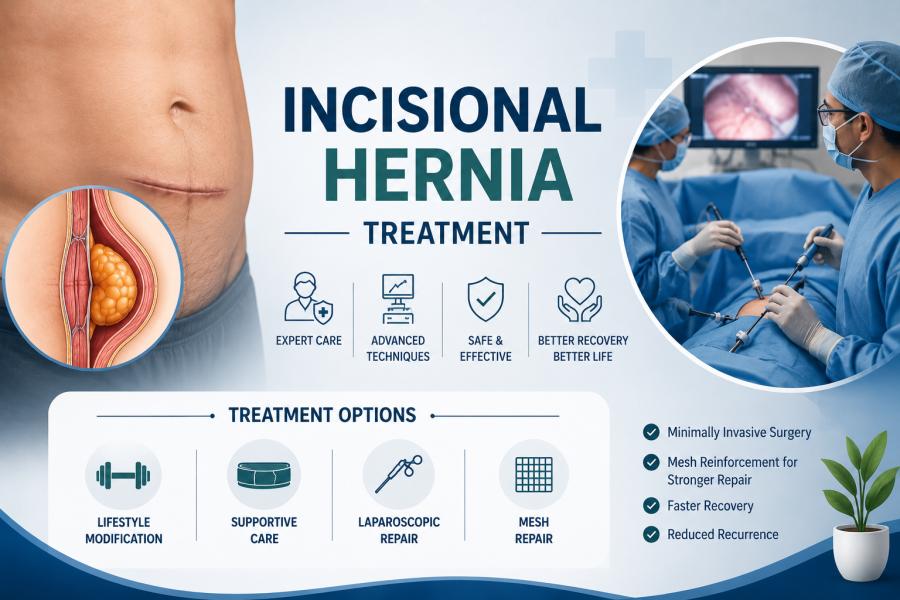
What Is an Incisional Hernia?
An incisional hernia happens after abdominal surgery. When a surgeon makes a cut (incision) in your belly to perform an operation, it leaves behind a healed wound. Sometimes, that area becomes weak. Over time, the inner tissue or organ can push through that weak spot — forming a bulge under the skin. This is called an incisional hernia. It is one of the most common complications after abdominal surgery. It can appear weeks, months, or even years after the original operation.
Causes of Incisional Hernia (Etiology):
Understanding the incisional hernia etiology helps you know your risk. An incisional hernia usually develops because the abdominal wall does not heal properly after surgery.
Common causes include:
- Post-surgical infection — Infection slows healing and weakens the tissue.
- Poor wound closure — If the incision was not sutured perfectly, the wall stays weak.
- Too much abdominal pressure — Coughing, straining, or lifting too soon after surgery.
- Obesity — Extra weight puts constant pressure on the abdominal wall.
- Smoking — It reduces blood flow and delays wound healing.
- Poor nutrition — A low-protein diet affects tissue repair.
- Diabetes — Slows the body’s natural healing process.
- Advanced age — Older patients heal more slowly.
Can an Incisional Hernia Happen After Laparoscopic Surgery?
Yes, it can. Incisional hernia after laparoscopic surgery is less common than after open surgery, but it does occur. Even small port-site incisions (5 mm or 10 mm) used in laparoscopic procedures can develop into a hernia. This is called a port-site hernia. If you notice any new bulge near an old laparoscopy scar, consult Dr. Samrat Jankar immediately.
Incisional Hernia Symptoms — What to Watch For?
Most incisional hernias start small and grow over time.
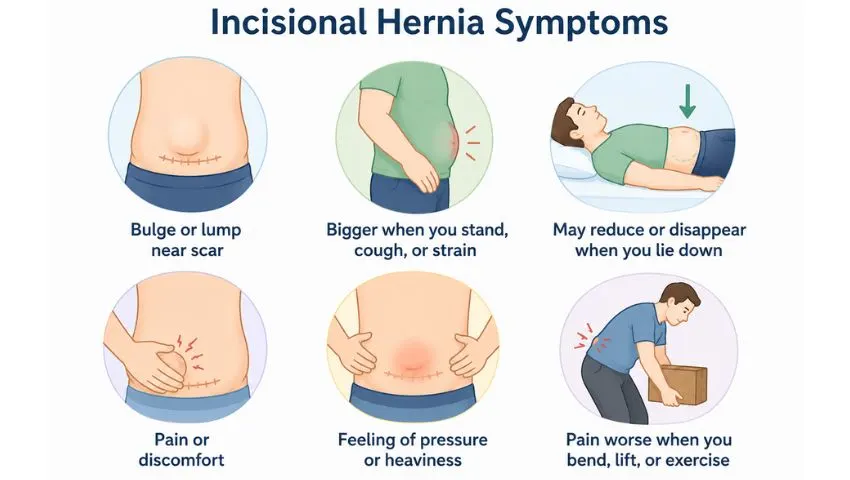
Common incisional hernia symptoms include:
- A visible bulge or lump near your old surgical scar
- The bulge is bigger when you stand, cough, or strain
- The bulge may reduce or disappear when you lie down
- Pain or discomfort at the hernia site
- A feeling of pressure or heaviness in the abdomen
- Pain that gets worse when you bend, lift, or exercise
Warning Signs — See a Doctor Immediately:
Some symptoms mean the hernia has become an emergency.
Go to the hospital right away if you have:
- Suddenly, severe pain at the hernia site
- The bulge becomes red, dark, or very tender
- Nausea and vomiting that do not stop
- Cannot push the bulge back in
- Constipation or inability to pass gas
This could mean the hernia is strangulated — meaning the blood supply to the trapped tissue is cut off. This is a medical emergency.
How is an incisional hernia diagnosed?
Dr. Jankar begins with a physical examination. He will ask you about your previous surgery, your symptoms, and how long you have had the bulge.
Diagnosis may also include:
- Ultrasound scan — To confirm the hernia and check its size.
- CT scan (Computed Tomography) — For larger or complex hernias. It shows the exact size, location, and what is inside the hernia sac.
A proper diagnosis helps Dr. Jankar plan the best treatment for you.
Incisional Hernia Treatment Options in Pune:
There are two main approaches to incisional hernia treatment — surgical and non-surgical.
Does Incisional Hernia Require Surgery?
For most patients, yes, surgery is required. An incisional hernia does not go away on its own. Without surgery, it usually gets bigger and more painful. There is also a risk of serious complications like strangulation. Surgery is the only permanent cure for an incisional hernia.
Option 1 — Laparoscopic Incisional Hernia Repair in Pune (Keyhole Surgery):
This is the most preferred method at Kaizen Gastro Care. Laparoscopic hernia repair uses 3–5 small incisions (about 5–10 mm each). A tiny camera (laparoscope) is inserted, and the surgeon watches the surgery on a screen. Surgical tools repair the hernia from the inside.
A surgical mesh is placed over the weak area to strengthen the abdominal wall and prevent the hernia from coming back.
Benefits of laparoscopic incisional hernia repair:
- Very small cuts — minimal scarring
- Less post-operative pain
- Shorter hospital stay (usually 1–2 days)
- Faster recovery — return to daily activities in 10–14 days
- Lower risk of infection
- Lower recurrence rate due to mesh reinforcement
Dr. Jankar has performed 1,000+ hernia repairs using laparoscopy. It is his most recommended approach for eligible patients.
Option 2 — Open Incisional Hernia Repair:
This is the traditional approach. The surgeon makes a larger incision directly over the hernia. The herniated tissue is pushed back in. The weakened area is then closed with sutures or reinforced with a mesh.
Open surgery is recommended when:
- The hernia is very large
- Multiple hernias are present
- There is a bowel obstruction or strangulation
- The patient has had previous repairs that failed
- Laparoscopic access is not possible
Recovery is longer — typically 3–6 weeks.
Option 3 — Robotic Hernia Repair in Pune:
Dr. Jankar also offers robotic-assisted hernia repair for complex cases.
Robotic surgery combines the benefits of laparoscopy with greater precision and control. It is particularly useful for large or recurrent hernias where fine movements matter most.
Option 4 — Non-Surgical Management (Watchful Waiting):
In some cases, surgery may be delayed temporarily.
Non-surgical treatment may be suitable if:
- The hernia is very small
- You have no pain or discomfort
- You have other serious health conditions that make surgery risky
Non-surgical options include:
- Hernia belt or truss — A supportive garment that holds the hernia in place and prevents it from getting worse.
- Weight loss — Reducing abdominal pressure by managing your weight.
- Dietary changes — Avoiding constipation and straining during bowel movements.
- Activity modification — Avoiding heavy lifting and strenuous exercise.
Important: Non-surgical management does not repair the hernia. It only controls symptoms temporarily. Dr. Jankar will monitor your condition and advise surgery when needed.
Incisional Hernia Surgery Cost in Pune:
The incisional hernia surgery cost in Pune depends on several factors.
Factors that affect the cost:
- Type of surgery (laparoscopic, open, or robotic)
- Size and complexity of the hernia
- Type of mesh used
- Hospital room chosen
- Duration of hospital stay
- Patient’s overall health condition
General cost range in Pune:
- Open hernia repair: ₹20,000 – ₹60,000
- Laparoscopic hernia repair: ₹40,000 – ₹90,000
- Robotic hernia repair: ₹80,000 – ₹2,00,000
➤ Note: Health insurance covers hernia surgery in most cases. EMI options may also be available. Contact Kaizen Gastro Care for a personalised cost estimate.
- Call: 079041 39064 for an exact quote based on your condition.
Why Choose Dr. Samrat Jankar for Incisional Hernia Treatment in Pune?
Dr. Samrat Jankar is one of the most trusted names for hernia treatment in Pune and PCMC.
Here is why thousands of patients choose him:
- 17+ years of surgical experience in gastroenterology and GI surgery
- 1,000+ successful hernia repair surgeries using laparoscopy
- Specialist in laparoscopic, robotic, and open hernia repair
- Expert in handling complex and recurrent hernias
- Patient-first approach — he explains your condition clearly and answers all your questions
- Practice at Kaizen Gastro Care, a well-equipped speciality centre in Pune
- Serving patients from Pune, PCMC, Pimpri-Chinchwad, and Maharashtra
- Affiliated with leading hospitals across the region
Dr. Jankar believes every patient deserves clarity, comfort, and the best possible outcome.
Book a Consultation with Hernia Specialist Dr. Samrat Jankar:
Are you experiencing a bulge near your old surgery scar?
Do not wait for it to get worse.
Dr. Samrat Jankar at Dr. Samrat Jankar Clinic, Pune, is ready to help you. He will assess your condition, explain your options clearly, and recommend the best treatment for you.
Early treatment means faster recovery and fewer risks.
FAQ's about incisional hernia:
No. An incisional hernia does not heal by itself. It usually grows larger over time. Surgery is the only permanent solution. However, in a few selected cases, watchful waiting is done under medical supervision.
Temporarily, yes. A hernia belt or lifestyle changes can manage symptoms. But they do not repair the hernia. Surgery is needed for a complete and lasting cure. Your doctor will guide you based on your condition.
Not always. If the hernia is small and not causing major symptoms, your doctor may monitor it. But if the hernia is growing, painful, or causing complications, surgery is recommended as soon as possible.
After laparoscopic surgery, most patients return to light activities in 10–14 days. Full recovery takes about 4–6 weeks. After open surgery, recovery takes 3–6 weeks. Dr. Jankar gives personalised recovery guidance to every patient.
Yes. Even the small port-site incisions used in laparoscopic surgery can develop into a hernia. This is less common than after open surgery, but it does happen. Any new bulge near a previous laparoscopy scar should be evaluated immediately.
The ICD-10 codes used for incisional hernia are:
- 0 — with obstruction, without gangrene
- 1 — with gangrene
- 2 — without obstruction or gangrene
In most cases, yes. Laparoscopic repair means smaller cuts, less pain, faster recovery, and lower infection risk. However, open surgery is better for very large or complex hernias. Dr. Jankar will recommend the right approach after evaluating your specific condition.
An untreated hernia usually grows larger. It can lead to serious complications like bowel obstruction or strangulation, where the blood supply to the trapped tissue is cut off. This becomes a surgical emergency. Early treatment is always safer.