
- 25/09/2023
- Dr. Samrat Jankar
- 0 Comments
- Blog
Different Types of Piles and How to Identify Them
Piles (medically known as haemorrhoids) are one of the most common ano-rectal conditions affecting millions of people in India and worldwide. If you have noticed bleeding during bowel movements, itching, or swelling around the anal area, you may be experiencing one of the several types of piles.
In this comprehensive guide by Dr. Samrat Jankar — the best piles specialist in Pune — we explain all types of piles, their grades, how to identify them early, their causes, and what treatment options are available. Understanding your condition is the first step towards effective treatment.
What Are Piles?
What Is the Medical Definition of Piles?
Piles, or haemorrhoids, are swollen and inflamed veins located in the rectum or around the anus. These enlarged veins form cushion-like structures that can bleed, itch, cause pain, or protrude outside the anal canal depending on the type and severity.
The term “piles” comes from the Latin word “pila” meaning ball. In medical terminology, they are called haemorrhoids — from the Greek words for blood (haima) and flowing (rhoos).
Other Names for Piles Disease
What Are Piles a Sign Of?
Piles can be a sign of chronic constipation, a low-fibre diet, prolonged sitting or straining, pregnancy, obesity, or a family history of the condition. In rare cases, rectal bleeding may indicate other conditions like colorectal polyps or colorectal cancer, which is why a proper diagnosis by a Proctologist in Pune like Dr. Samrat Jankar is always recommended.
How Many Types of Piles Are There?
There are 4 main types of piles based on their location and nature:
• — form inside the rectum Internal Piles
• — form under the skin around the anus, External Piles
• — internal piles that protrude outside the anus: Prolapsed Piles
• — piles with a blood clot inside Thrombosed Piles
Additionally, internal piles are classified into 4 grades (Grade I through Grade IV) based on severity.
Type 1: Internal Piles — Symptoms, Grades & Stages
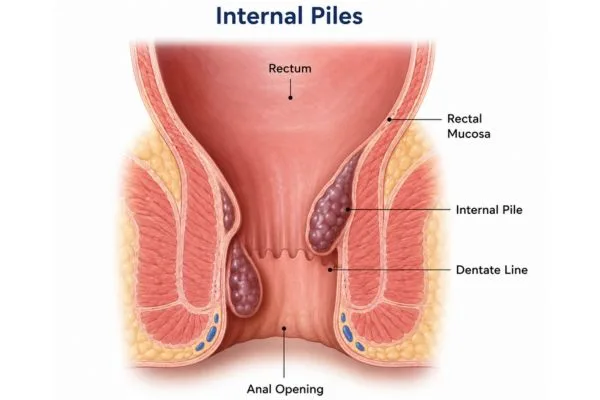
What Are Internal Piles?
Internal piles develop inside the rectum, above the dentate line (the dividing point between the upper and lower anal canal). Because the upper anal canal has fewer pain-sensing nerve endings, internal piles are often painless — even when they bleed. The most characteristic symptom of internal piles is bright red blood on toilet paper or in the toilet bowl after passing stool — without any pain.
Symptoms of Internal Piles
- Bright red, painless rectal bleeding during bowel movements
- Feeling of incomplete bowel emptying (incomplete evacuation)
- Mucus discharge from the anus
- Anal itching or irritation
- A feeling of fullness or heaviness in the rectum
4 Grades of Internal Piles — Complete Stage Guide
Internal piles are graded from I to IV based on how much they prolapse (protrude). Understanding your grade helps determine the most appropriate treatment.
Which Stage of Piles Is Dangerous?
Grade IV internal piles are the most dangerous. At this stage, the haemorrhoid is permanently prolapsed and cannot be reduced manually. There is a risk of strangulation (blood supply gets cut off), leading to severe pain, necrosis (tissue death), and infection. Grade IV always requires surgical intervention — do not delay treatment.
Understanding how piles progress helps you act before they worsen:
- Stage 1 (Grade I): Small internal swellings. No visible symptoms. Only detected on examination. Treat with diet changes.
- Stage 2 (Grade II): Prolapse during bowel movement, retracts on own. Bleeding during defecation. Treat with banding.
- Stage 3 (Grade III): Prolapse requires manual reduction. Increasing discomfort. Surgical or procedure-based treatment needed.
- Stage 4 (Grade IV): Permanently prolapsed. Severe complications possible. Surgical removal required.
Type 2: External Piles — What They Look Like & Early Stage Signs
What Are External Piles?
External piles (external haemorrhoids) develop under the skin around the outside of the anus, below the dentate line. This area is rich in pain-sensing nerve fibres, which is why external piles tend to be significantly more painful than internal ones.
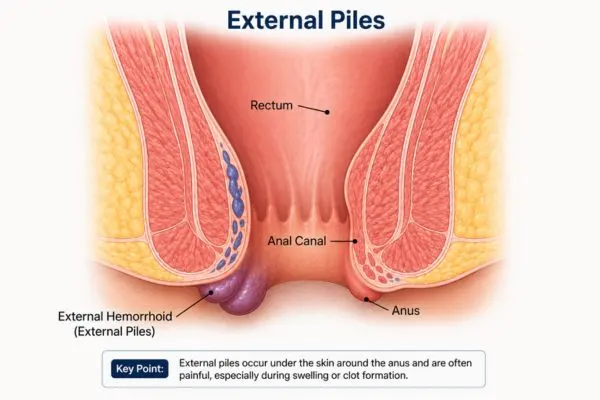
Symptoms of External Piles
- Pain or discomfort, especially when sitting
- Swelling or a hard lump around the anal area
- Itching and irritation around the anus
- Bleeding (less common than with internal piles)
- Difficulty cleaning the anal area after bowel movements
How Do External Piles Look in the Early Stage?
In the beginning stage, external piles may appear as small, soft, reddish or bluish swellings just outside the anal opening. They can feel like a pea-sized lump. During a flare-up, they become more prominent, harder, and darker in colour — especially if a blood clot has formed (thrombosed external piles).
Piles Beginning Stage — What to Watch For
Early signs that you may be developing piles include:
- Slight itching or irritation that doesn’t go away
- Very mild discomfort or heaviness after prolonged sitting
- A small amount of bright red blood on toilet paper (not in the stool)
- A small bump near the anus that appears intermittently
Identifying piles in the early stage gives the best chance for successful conservative management without surgery.
Type 3: Prolapsed Piles — Signs, Stages & Risks
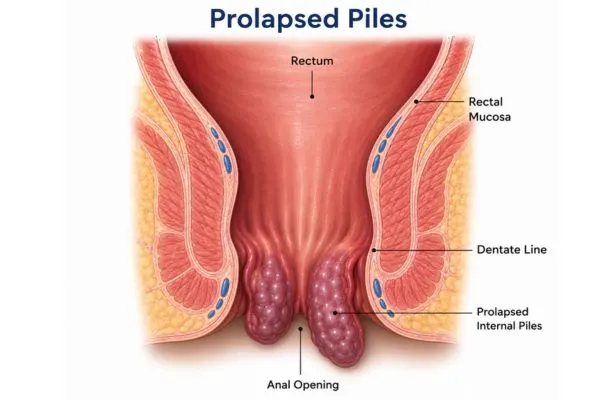
What Are Prolapsed Piles?
Prolapsed piles are internal piles (Grade II, III, or IV) that have extended beyond the internal anal canal and protrude outside the anus. They are usually pink or red in colour and may appear as a soft tissue mass protruding from the anal opening.
Symptoms of Prolapsed Piles
- Visible protrusion of tissue from the anus
- Significant pain, especially during and after bowel movements
- Heavy bleeding
- Mucous discharge and feeling of wetness around the anus
- Difficulty sitting for extended periods
- In severe cases: inability to reduce the prolapse manually
How to Identify Prolapsed Piles
Grade II piles prolapse during straining but return inside on their own. Grade III piles prolapse and require manual reduction (you need to push them back in with a finger). Grade IV piles remain permanently outside. If you notice tissue protruding from the anus that does not retract, this is a medical emergency requiring immediate attention.
Type 4: Thrombosed Piles — Causes, Pain & Treatment Urgency
What Are Thrombosed Piles?
Thrombosed piles occur when a blood clot (thrombus) forms inside an external or, less commonly, internal haemorrhoid. The clot prevents blood from flowing normally, causing rapid swelling, intense pain, and a characteristic dark blue or purple appearance.
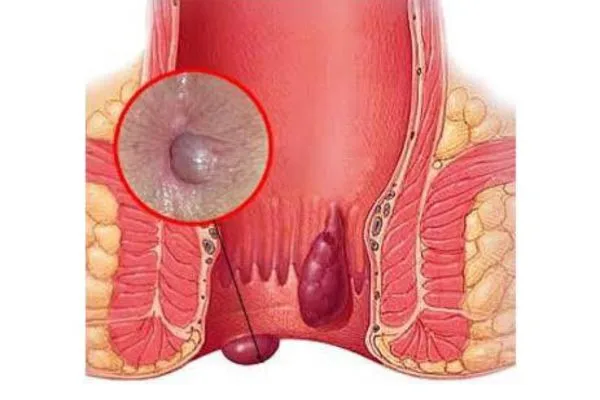
Symptoms of Thrombosed Piles
- Sudden, severe anal pain that often comes on rapidly
- A hard, bluish-purple lump at the anus
- Significant swelling
- Difficulty walking, sitting, or performing daily activities
- The pain is typically constant — unlike other types which hurt mainly during bowel movements
Is Thrombosed Piles Dangerous?
Thrombosed piles are not life-threatening if treated promptly, but they cause extreme discomfort and can become complicated. If left untreated, the overlying skin may break down, causing ulceration, infection, or abscess formation. Treatment within 72 hours (incision and removal of the clot) gives the best outcome and fastest pain relief.
Types of Piles in Males vs Females
Types of Piles in Males — Specific Risk Factors
Men develop piles for many of the same reasons as women, but with some specific triggers:
- Heavy weightlifting or strenuous physical labour — increases intra-abdominal pressure
- Chronic constipation from low-fibre diet and insufficient hydration
- Prolonged sitting at a desk or on the toilet
- Alcohol consumption, which causes dehydration and harder stools
- Family history — genetics play a role in vein wall strength
Men often delay seeking treatment due to embarrassment, allowing piles to progress from Grade I to Grade III or IV before consulting a specialist. Early consultation with a colorectal specialist like Dr. Samrat Jankar can prevent the need for surgery.
Types of Piles in Females — Pregnancy-Related Piles
Women are particularly prone to piles during pregnancy and after childbirth. Reasons include:
- The growing uterus compresses veins in the pelvis, reducing blood flow from the lower body
- Hormonal changes (increased progesterone) relax vein walls, making them more prone to swelling
- Pushing during labour significantly increases pressure on the pelvic veins
- Iron supplements taken during pregnancy can cause constipation
Pregnancy-related piles often improve after delivery but may persist. Dr. Samrat Jankar recommends gentle management during pregnancy and a proper evaluation after delivery if symptoms continue.
How to Identify Piles — Complete Symptoms Guide
Piles Beginning Stage Symptoms — Early Warning Signs
Many people ignore the early symptoms of piles, allowing the condition to progress. Watch for these early warning signs:
- Occasional bright red blood on toilet paper — not mixed in the stool
- Mild itching or irritation around the anus, especially after bowel movements
- Slight discomfort or heaviness in the anal region
- A feeling of not fully emptying the bowel
- Intermittent soft swelling that appears and disappears near the anus
Piles Symptoms in Males
In males, piles most commonly present as painless rectal bleeding (internal piles) or a painful lump near the anus (external piles). Itching and discomfort during and after bowel movements are frequently reported. Many men notice blood on toilet paper or bright red blood in the toilet bowl.
Piles Symptoms in Females
Women often experience piles as intense itching, burning, and discomfort, particularly during pregnancy. Prolapse (tissue coming out during bowel movements) is more frequently reported by women, especially those who have had multiple vaginal deliveries.
Best Piles Specialist in Pune — Dr. Samrat Jankar
If you are experiencing any of the symptoms described in this guide, do not delay seeking expert evaluation. Dr. Samrat Jankar is widely regarded as the best piles doctort in Pune, with extensive experience in diagnosing and treating all types and grades of haemorrhoids.
Why Choose Dr. Samrat Jankar for Piles Treatment?
- MCh (Surgical Gastroenterology) — Super-specialist qualification
- FMAS (Fellow of Minimal Access Surgery) — Expert in minimally invasive techniques
- 17+ years of experience treating complex colorectal conditions
- Specialist in Laser Haemorrhoidoplasty, MIPH Stapling, and LigaSure Haemorrhoidectomy
- Daycare procedures — most patients go home the same day
- Comprehensive evaluation including proctoscopy and colonoscopy on-site
- Treating patients from across Pune, Pimpri-Chinchwad, PCMC, and Maharashtra
For appointments, please visit: www.drsamratjankar.com or call the clinic directly.
Conclusion:
Piles is a common, treatable condition — but it requires accurate identification of the type and grade for the most effective treatment. Whether you have early-stage internal piles with painless bleeding, or advanced Grade IV prolapsed piles requiring surgery, the right specialist makes all the difference.
This guide has covered all 4 types of piles — internal, external, prolapsed, and thrombosed — along with their grades, symptoms, causes, how to identify them, diagnosis methods, and treatment options in detail.
If you are based in Pune or anywhere in Maharashtra, consult Dr. Samrat Jankar, the best piles specialist in Pune, for a thorough evaluation and personalised treatment plan. Early diagnosis leads to less invasive treatment and faster recovery.
Visit Dr. Samrat Jankar Clinic in Wakad, Pune | Book your appointment today.
Frequently Asked Questions About Types of Piles
There are 4 main types of piles: internal, external, prolapsed, and thrombosed. Internal piles are further classified into 4 grades (I–IV) based on severity.
Internal piles develop inside the rectum and are usually painless but cause bright red bleeding. External piles develop under the skin around the anus and are typically painful with itching and swelling.
Grade IV internal piles are the most dangerous stage. At this point, the haemorrhoid is permanently prolapsed and cannot be manually reduced. There is a risk of strangulation and tissue death. Surgical treatment is urgently required.
Grade I and Grade II piles can usually be managed without surgery through dietary changes, rubber band ligation, and sclerotherapy. Grade III and Grade IV piles typically require minimally invasive procedures or surgery for permanent relief.
In the early stage, internal piles are not visible from outside. External piles in early stages appear as small, soft, reddish or bluish swellings near the anus. The first noticeable symptom is often a small amount of bright red blood on toilet paper.
Piles affect both males and females equally. However, females have an added risk during pregnancy and after childbirth. Males often present at a more advanced stage due to delay in seeking treatment.
Piles are diagnosed through clinical examination, digital rectal examination (DRE), and proctoscopy. Colonoscopy may be recommended for patients above 45 years or those with significant symptoms.
Dr. Samrat Jankar at Kaizen Gastro Care, Pune offers the latest minimally invasive treatments including Laser Haemorrhoidoplasty, Stapled Haemorrhoidopexy (MIPH), and LigaSure Haemorrhoidectomy — with daycare facility and rapid recovery.